Why Venezuela Matters
Oil, Refineries, and Power in the Western Hemisphere — Understanding the forces behind Operation Absolute Resolve
On January 3, 2026, U.S. forces captured Venezuelan President Nicolas Maduro in an operation codenamed "Absolute Resolve." President Trump announced the United States would "run" Venezuela until a transition could occur.
This essay explains the systems behind the headlines.
Venezuela sits atop 303 billion barrels of oil — the world's largest proven reserves. But it produces only about 1 million barrels per day, a fraction of its historical 3.5 million. This paradox reflects not geology but governance: decades of underinvestment, mismanagement, and sanctions have created an oil industry that struggles to extract the resources beneath it.
Meanwhile, U.S. Gulf Coast refineries were built to process exactly the kind of heavy, sour crude that Venezuela produces — and that American shale does not. The United States both exports light crude and imports heavy crude because they are not substitutable. Billions of dollars in specialized refinery equipment cannot simply switch.
Venezuela in One Paragraph
Venezuela occupies the northern coast of South America, facing the Caribbean Sea. Thirty million people live across a geography that spans Andean highlands, Amazon jungle, and coastal plains. Its capital, Caracas, sits in a valley behind the coastal mountains.
But what makes Venezuela matter to the world sits underground.
The country holds the world's largest proven oil reserves: approximately 303 billion barrels, surpassing Saudi Arabia. The Energy Information Administration and OPEC's Annual Statistical Bulletin confirm this figure year after year.
Yet Venezuela produces only about 1 million barrels per day — roughly 1% of global production. In the 1990s, it produced over 3.5 million barrels per day. The collapse is not geological. The oil is still there.
The collapse is political, economic, and institutional. Understanding why requires understanding the oil itself.
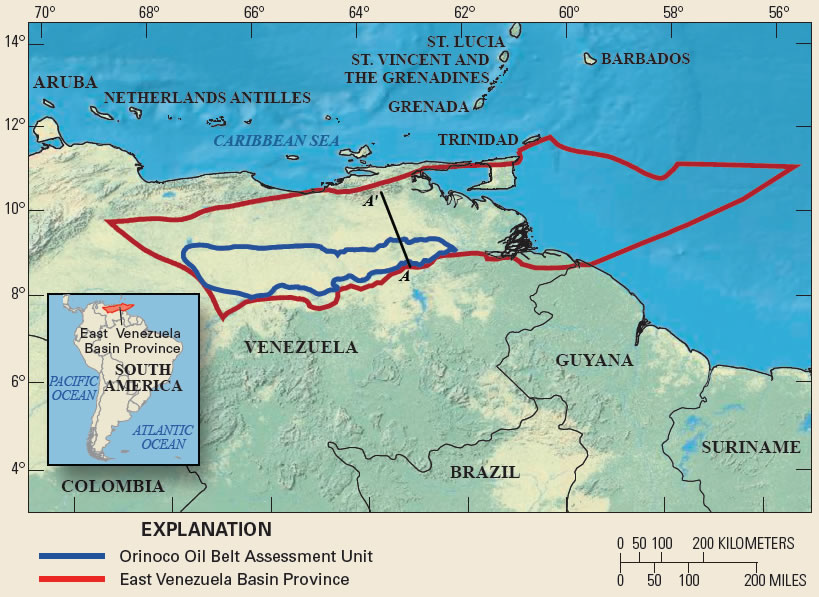
The Orinoco Belt: 600km of heavy crude deposits. Source: U.S. Geological Survey (Public Domain)
The Oil That Doesn't Behave: Orinoco, Heavy Crude, and Refinery Physics
The Orinoco Belt stretches 600 kilometers across eastern Venezuela, roughly 70 kilometers wide. The U.S. Geological Survey estimates it contains 900 to 1,400 billion barrels of heavy crude in proven and unproven deposits. Of this, 380 to 652 billion barrels may be technically recoverable.
These are staggering numbers. But "reserves" does not equal "production."
The Chemistry Problem
Oil density is measured on the API gravity scale...
Higher API gravity = lighter oil. Gulf Coast refineries were built for heavy crude like Venezuela produces.
The sulfur problem
Orinoco crude is "sour" — high in sulfur content. Sulfur must be removed during refining (it creates air pollution and corrodes equipment). Desulfurization is expensive.
Heavy, sour crude requires complex refineries with specific equipment:
- Cokers: Break down heavy residual oil into lighter products
- Hydrocrackers: Use hydrogen and pressure to convert heavy molecules
- Desulfurization units: Remove sulfur to meet environmental standards
Not all refineries have this equipment. Most were built for lighter, sweeter crudes. The ones that have it represent billions of dollars in sunk costs.
The U.S. Paradox: Producing Light, Needing Heavy
The U.S. Gulf Coast (PADD 3 in EIA terminology) hosts the largest concentration of complex refineries in the world. These facilities were constructed decades ago to process heavy, sour crude — the kind that once flowed abundantly from Venezuela and Mexico.
The U.S. Paradox
The shale revolution made the U.S. the world's largest oil producer — 13M barrels per day.
Gulf Coast refineries represent billions in specialized equipment that cannot simply switch to processing light shale oil.
The structural mismatch
For the 12 months ending in February 2025, Gulf Coast refiners imported roughly 40 million barrels of heavy crude each monthEIA. This is not a choice. It's a necessity. The equipment cannot efficiently process light shale oil.
Who supplies heavy crude?
- Canada: Now the largest single supplier, exporting over 4 million barrels per day from Alberta's oil sandsEIA
- Mexico: Historically important, but collapsing — Maya crude exports down to 22,000 barrels/day, a six-year lowS&P Global
- Venezuela: Once supplied millions of barrels monthly; now reduced to a trickle under sanctions
The result: The United States simultaneously exports light crude and imports heavy crude. These are not substitutable products. The wrong-shaped key does not fit the lock.
Qualitative illustration of the structural mismatch between U.S. production and refinery requirements.
Power as Flow Control: Shipping, Sanctions, and Institutional Levers
If you control the flows, you control the power.
U.S. sanctions against Venezuela have evolved across three administrations, each tightening the economic pressure:
Initial targeted sanctions on individuals
Sanctions on PDVSA, oil sector designations
DOJ indicts Maduro on narco-terrorism charges
Chevron receives license to resume operations
Maximum pressure reinstated — export blockade, additional designations
Color indicates policy direction: escalation, legal action, relief
By December 2025, the situation had become acute. OFAC designated additional companies and tankers. A de facto blockade prevented vessels from entering or leaving Venezuelan ports.
PDVSA's storage approached capacity: 25 million barrels of crude and fuel oil with nowhere to go. Industry sources told Reuters the situation was "getting ugly." Without tanker departures, the company risked shutting down refining units.
This is how sanctions work when they work. Not through military action, but through the slow strangulation of logistics. Ships that cannot move. Oil that cannot flow. Revenue that cannot arrive.
The Monroe Doctrine Returns
In 1823, President James Monroe declared to Congress that the Western Hemisphere would not be subject to further European colonization. Any attempt by European powers to extend their influence would be viewed as "the manifestation of an unfriendly disposition toward the United States."
This was not international law. It was not a treaty. It was an assertion of hemispheric influence — a claim that this half of the planet belonged to America's sphere.
For two centuries, the Monroe Doctrine has been invoked, forgotten, and revived. Its most recent manifestation: the "Trump Corollary."
The 1989 precedent
Operation Just Cause in Panama. U.S. forces invaded, captured General Manuel Noriega, and flew him to the United States to face drug charges. He was tried, convicted, and died in custody in 2017.
The parallels are not subtle. Same justification (drugs). Same method (military capture). Same destination (federal court in New York).
From peak production to capture: Venezuela's oil output collapsed from 3.5M to ~1M barrels per day.
Operation Absolute Resolve
- Explosions heard across Caracas
- 150+ aircraft: B-1B, F-22, F-35, F/A-18, EA-18G, E-2
- Targets: Military installations, air defenses
- Delta Force and law enforcement lead extraction
- Maduro and Cilia Flores located
- Trump: "gave up without a fight"
- Amphibious assault ship stationed offshore
- Charges: Narco-terrorism, cocaine importation, weapons
- Jurisdiction: Southern District of New York
"The United States of America has successfully carried out a large-scale strike against Venezuela and its leader, President Nicolas Maduro, who has been, along with his wife, captured and flown out of the country."— Donald Trump, Truth Social, January 3, 2026
"We are going to run the country until such time as we can do a safe, proper and judicious transition."— Donald Trump, Press Conference, January 3, 2026
Legality and Legitimacy: Two Rulebooks, One Precedent
The operation faces legal challenges on two fronts: domestic U.S. law and international law. Neither is settled.
The Domestic Test
The Constitution: Article I gives Congress the power to declare war. The President commands the military but requires authorization for offensive operations.
The War Powers Resolution (1973): Enacted after Vietnam, this law requires the President to notify Congress within 48 hours of introducing forces into hostilities and to withdraw within 60 days without congressional authorization.
The administration's argument: Secretary of State Rubio reportedly told Senator Mike Lee that "the kinetic action we saw tonight was deployed to protect and defend those executing the arrest warrant." The argument: This was law enforcement, not war.
The critics' argument: Senator Tim Kaine told NPR, "I think these strikes are clearly illegal. They have not been authorized by Congress."
The International Test
UN Charter Article 2(4): "All Members shall refrain in their international relations from the threat or use of force against the territorial integrity or political independence of any state."
Exceptions: Self-defense (Article 51) or UN Security Council authorization. Neither applies here.
"Independently of the situation in Venezuela, these developments constitute a dangerous precedent. The Secretary-General continues to emphasize the importance of full respect — by all — of international law, including the UN Charter."— Antonio Guterres, UN Secretary-General, January 3, 2026
Legal status is contested on domestic grounds and broadly criticized on international grounds.
Stakeholders: Venezuela, the Region, the Great Powers, the Markets
The Condemnation Bloc
"Firmly opposes such hegemonic behavior by the U.S."
Received ~80% of Venezuela's oil exports pre-blockade"Unfounded pretexts"
Military sales agreements & strategic investments"State terrorism"
Long-standing Maduro ally"Assault on the sovereignty of Latin America"
Pres. Petro ordered military deployment to border"Crossed an unacceptable line"
President Lula"Violates the principle of not resorting to force"
Cites international lawThe Cautious Bloc
"The legal assessment is complex"
Leader Merz: "will take our time"Emergency session convening January 5
Requested by Colombia, Russia, ChinaConceptual illustration. Actual market response depends on escalation, supply disruption duration, and policy response.
Why Venezuela Is Not Iraq (and what can still go wrong)
The comparisons are inevitable. Both involve U.S. military action to remove a leader. Both are justified partly through drug/security framing. Both raise sovereignty questions.
But the differences matter:
Geography
Iraq is 6,000 miles from the United States. Venezuela shares the Caribbean with the Gulf Coast. Supply lines are shorter. Evacuation is easier. But so is the reverse: any Venezuelan threat to U.S. interests is also closer.
Oil Type
Iraq's oil is light. Venezuela's is heavy. U.S. refineries need Venezuelan-type crude. This creates structural dependence regardless of who controls Caracas.
What Can Still Go Wrong
- Military fragmentation: If Venezuelan forces splinter into factions, the country becomes ungovernable
- Proxy resistance: Cuba, Russia, or Iran could provide arms to resistance movements
- Cyber attacks: Venezuelan or allied actors could target U.S. infrastructure
- Migration surge: Economic chaos could trigger another wave of Venezuelan emigration
- Regional destabilization: Colombia and Brazil face direct spillover risks
A Clean Exit Checklist (systems, not slogans)
What would "success" require? Not rhetoric, but systems:
- Legitimate successor government formed
- Military/security forces aligned or neutralized
- PDVSA operational control established
- Sanctions framework clarified
- International recognition secured
- Humanitarian corridor for migration
- Oil production stabilized
- Export infrastructure restored
- Regional diplomatic relations normalized
- Congressional authorization (retroactive or new)
- Legal challenges resolved
Each item has dependencies. None happens automatically.
What to Watch Next
This Week
- UN Security Council (January 5): What resolutions are proposed?
- Maduro arraignment (Monday): What charges proceed?
- Venezuelan military posture: Resistance, cooperation, or fragmentation?
- PDVSA operations: Do exports resume? Under whose authority?
Coming Weeks
- Congressional action on War Powers resolutions
- Regional responses from Colombia, Brazil, Caribbean states
- International legal proceedings
- Market stabilization or continued volatility
Ongoing
- Governance implementation: What does "running the country" look like?
- Disinformation monitoring: AI-generated content will continue spreading
- Economic recovery (or not): Venezuela's economy collapsed before the intervention
FAQ
1. Was this legal under U.S. law? Under international law?
Both are contested. U.S. law: The administration claims Article II authority; critics say Congress should have authorized. International law: The UN Charter prohibits use of force except in self-defense or with Security Council authorization. Neither applies. UN Secretary-General Guterres called it a "dangerous precedent."
2. Is this about oil, drugs, democracy, or all three?
All three. The formal justification is narco-terrorism. The political justification is restoring democracy after disputed elections. The structural reality is that Venezuela has oil U.S. refineries need. These motives are not mutually exclusive.
3. What changes if leaders can be seized abroad?
This is the precedent question. If sovereignty can be violated for drug charges, what limits exist? The UN Security Council will debate this. The answer will emerge over years, not days.
4. What happens to PDVSA, ports, and exports?
Uncertain. PDVSA facilities reportedly operated normally after the strikes. But exports were already halted under the blockade. Who controls export decisions remains unclear.
5. Why do refineries care about heavy crude specifically?
Gulf Coast refineries were built with billions in specialized equipment (cokers, hydrocrackers) designed for heavy sour crude. U.S. shale produces light sweet crude — a different product. They are not interchangeable.
6. What would a "clean exit" require?
At minimum: legitimate successor government, military cooperation, PDVSA operational control, clarified sanctions, international recognition, and resolution of legal challenges. Each has dependencies.
7. What are the risks of escalation?
Military fragmentation, proxy resistance from Cuba/Russia/China, cyber attacks on U.S. infrastructure, migration surge, regional diplomatic breakdown, and extended occupation costs.
8. How should I evaluate social media videos and images right now?
With extreme skepticism. AI-generated images of Maduro's arrest have been confirmed circulating. Old footage from 2024 has been recycled as current. Look for wire service (Reuters, AP) sourcing. When in doubt, wait.
Glossary
Oil & Energy
- API gravity
- Measure of oil density; higher numbers indicate lighter crude that flows more easily
- Heavy crude
- Oil with low API gravity (<22°), thick consistency, requires specialized refining equipment
- Sour crude
- Oil with high sulfur content (>0.5%), requires desulfurization before processing
- Coker
- Refinery unit that thermally cracks heavy residual oil into lighter, more valuable products
- PDVSA
- Petróleos de Venezuela, S.A. — Venezuela's state-owned oil and natural gas company
- Orinoco Belt
- 600km region in eastern Venezuela containing the world's largest heavy oil deposits
Legal & Political
- Monroe Doctrine
- 1823 U.S. foreign policy opposing European colonialism in the Western Hemisphere
- War Powers Resolution
- 1973 federal law requiring presidential notification to Congress within 48 hours of military action
- Ker-Frisbie doctrine
- Legal principle allowing prosecution regardless of how a defendant was brought before the court
- Narco-terrorism
- Terrorism funded through drug trafficking; carries enhanced federal penalties
Sources & Further Reading
Works Cited
Operation Absolute Resolve
Legal Analysis
Energy & Oil
Disinformation
Image Credits
All diagrams and charts are original creations for this essay.