धर्म
Dharma

“When righteousness falters, I descend.”
— Bhagavad Gita 4.7-8THE JOURNEY HOME
The Ramayana in Art and Symbol
“A story of exile, devotion, and the long way back”
The Cosmic Frame
Before time, before story
Vishnu reclines on the cosmic ocean — the universe dreams within him
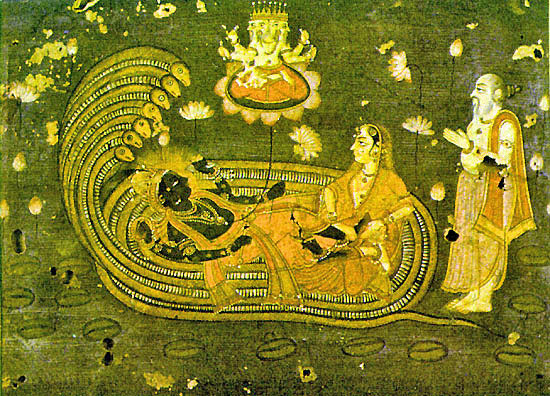
From Vishnu's navel, a lotus.
On the lotus, Brahma.
Creation within creation.
Ravana has accumulated power through austerities. He has a boon—no god or demon can kill him. He did not think to fear humans.
The cosmos requires a correction: the divine must descend in human form, subject to human limitations, to defeat what cannot otherwise be defeated.
This is the frame: a god chooses to forget his godhood, to become vulnerable, to suffer loss—all so that dharma can be restored.
The journey home is not just Rama's.
It is the cosmos returning to balance.
The Promise and the Exile

Rama is hours from coronation when his father's past catches up. Years ago, King Dasharatha promised his wife Kaikeyi any two boons. Now, poisoned by her maid Manthara's jealousy, she claims them: her son Bharata will be king; Rama will be exiled for fourteen years.
Dasharatha is shattered. He begs Rama to refuse, to take the throne by force. Rama refuses. Dharma demands that sons honor fathers' words.
“Where you go, I go. The forest with you is heaven; the palace without you is hell.”
— Sita (adapted from Valmiki Ramayana, Ayodhya Kanda)

Rama
मर्यादा पुरुषोत्तम — The Ideal ManDharma, righteous action, the human face of divinity“A promise is a promise, even when the promise is unjust.”


The Forest Years
The forest is not punishment—it is preparation. For thirteen years, Rama, Sita, and Lakshmana live among sages, learning, protecting the hermitages from demons, deepening their dharma.
But the forest is also where danger enters. Surpanakha, Ravana's sister, desires Rama. When rejected, she attacks Sita. Lakshmana cuts off her nose and ears. Humiliated, she runs to her brother.
Ravana sends Maricha disguised as a golden deer. Sita, enchanted, asks Rama to catch it. He pursues; the deer leads him far away.
Sita is alone. An old ascetic approaches, begging alms. She steps outside the protective boundary to give charity.
The ascetic is Ravana.
The Abduction
Ravana carries Sita across the sky in his flying chariot. Jatayu, the aged vulture king, friend to Rama's father, tries to stop him. Ravana cuts off his wings.
Sita is placed in the Ashoka grove, surrounded by demon guards. Ravana does not force himself on her—he wants her to choose him. He gives her one year.
She sits beneath an ashoka tree, meditating on Rama. She holds a blade of grass between them—you are worth no more than this.
Sita
भूमि पुत्री — The Earth's DaughterFertility, fidelity, the feminine divine, steadfast love“Her body is captive. Her spirit remains free.”
Hanuman
Among Sugriva's ministers is Hanuman—son of the wind god, cursed in youth to forget his powers until reminded at the right moment. When told he must leap across the ocean to Lanka, he remembers.
He grows vast. He leaps.
Hanuman
महाभक्त — The Perfect DevoteeDevotion, strength, celibacy, service, the power of the divine name“When he tears open his chest, Rama and Sita are within—there is no Hanuman separate from his love for them.”
In Lanka, he finds Sita. He offers to carry her back—he could. She refuses. Rama must come himself; dharma requires he defeat Ravana, not sneak away.
Hanuman allows himself to be captured so he can see Ravana's strength. They set his tail on fire; he escapes, burning Lanka as he goes.
The Bridge
The ocean bars the way. Rama meditates for three days, asking the ocean god for passage. Silence. On the fourth day, Rama raises his bow—he will dry the ocean with celestial weapons.
The ocean god appears, terrified. He cannot part himself, but he offers help: stones inscribed with Rama's name will float.
The army writes “Rama” on every stone. They float. For five days, millions of monkeys build the bridge to Lanka—the Setu, Ram Setu, still said to exist between India and Sri Lanka.
The War
The war lasts many days. Ravana's son Indrajit wields sorcery—serpent weapons bind the entire army. Lakshmana falls, pierced by a shakti weapon. He will die by dawn unless he receives herbs from a distant Himalayan peak.
Hanuman flies north. He cannot identify the herbs; he carries the entire mountain. Lakshmana lives.
Ravana
दशमुख — The Ten-Headed KingLanka, scholarship, power, desire that corrupts, the ego unchecked“He is not simple evil—he is brilliant, devout in his way, a master of arts. His flaw is desire unrestrained by dharma.”
One by one, Ravana's generals fall. His brothers. His sons. His armies. Still he will not surrender. Still he will not return Sita.
Finally, Rama and Ravana face each other. Rama fires an arrow blessed by Brahma. It strikes Ravana's heart—the one place his boon did not protect, because his pride never imagined a mere human could reach it.
Ravana falls. Lanka is silenced. The war is over.
The Fire Trial
A Note on Interpretation
This episode is painful. Different traditions interpret it differently—some as Rama's failing, some as cosmic necessity, some as later interpolation. We present it honestly, acknowledging the difficulty, letting viewers sit with discomfort.
Sita is brought before Rama. She expects embrace. He looks away.
“You have lived in another man's house for a year. How can I take you back? What will people say?”
She asks Lakshmana to build a pyre. She will enter the fire. If she is pure, it will not burn her.
She walks into the flames.
Agni, the fire god, rises with Sita in his arms—unburned, unscorched, radiant. She is pure. She has always been pure. They embrace. The war is truly over.
The Return
Fourteen years to the day. They fly home in Ravana's captured vimana, the magical flying chariot. Below them, they see the path of their exile—the forests, the mountains, the ocean, Lanka now at peace under Vibhishana's rule.
The people light every lamp in the city. The darkness will not touch this night.
This, tradition says, is the origin of Diwali.
Rama is crowned. Sita beside him. The brothers united. The kingdom flourishes. Dharma reigns. For a moment—it is enough. For a moment—the journey is complete.
The Shadow
Scholarly Context
The Uttara Kanda is widely considered a later addition to the original epic. Goldman's critical edition includes it with scholarly apparatus noting its contested status. We present the narrative as it shapes how millions understand the story, while acknowledging the scholarly debate.
Years pass. Sita is pregnant. The kingdom prospers—but a washerman refuses to take back his wife who spent a night away.
“I am no Rama, to accept a woman who has lived with another.”
— The washerman (Uttara Kanda)
Rama hears. He sends Sita away. Pregnant. Alone. To the forest.
Years later, she returns—but will not stay. She has been exiled twice. She calls to her mother, the earth. The ground opens. Sita descends. She does not return.
Rama rules for many more years, but alone. When he finally chooses to leave this world, he walks into the Sarayu River and does not emerge.
Sita's return to the earth is not defeat—it is reclamation. She came from the earth; she returns to it, on her own terms. The story does not pretend this is happy. It asks: was it worth it? It does not answer.
The Eternal Return
The Ramayana has been told for at least 2,500 years. It has crossed oceans—to Thailand, Cambodia, Indonesia, where Rama is Phra Ram, where the story adapts and endures.
Every autumn in India, millions gather for Ram Lila—dramatic retellings across days and nights. Every Diwali, lights celebrate the return to Ayodhya. Every temple contains Rama, Sita, Lakshmana, Hanuman—worshipped, alive, present.
The Ramayana does not end. Every time it is told, Rama is exiled again, Sita is taken again, the war is fought again, the return is made again. And every time we listen, we take the journey ourselves.
“Where are you in the story?”
Sources & Further Reading
Primary Texts
- Goldman, Robert P. (trans.) — The Rāmāyaṇa of Vālmīki. Princeton University Press, 1984–2017
- Pollock, Sheldon — Ayodhyākāṇḍa. Princeton University Press, 1986
- Richman, Paula (ed.) — Many Rāmāyaṇas. University of California Press, 1991
Art Historical Sources
- Guy, John (ed.) — Lost Kingdoms: Hindu-Buddhist Sculpture. Metropolitan Museum of Art, 2014
- Archer, W.G. — Indian Paintings from the Punjab Hills. Sotheby Parke Bernet, 1973
- Dehejia, Vidya — The Body Adorned. Columbia University Press, 2009
Scholarly Interpretation
- Lutgendorf, Philip — Hanuman's Tale. Oxford University Press, 2007
- Pattanaik, Devdutt — Sita: An Illustrated Retelling. Penguin India, 2013
- Brockington, John — The Sanskrit Epics. Brill, 1998
Living Tradition
- UNESCO — Ramlila, Traditional Performance of the Ramayana (Intangible Heritage)
- Lutgendorf, Philip — "Ramayan: The Video" The Drama Review, 1990
- Encyclopedia Britannica — Ramayana
Visual Sources
This essay presents the Ramayana through historical art: temple sculpture from Angkor Wat, Prambanan, and Mahabalipuram; Chola bronzes from the Tamil Nadu tradition; Pahari and Rajasthani miniature paintings; and Southeast Asian interpretations. All visual sources are documented with period, tradition, and collection where known. This is a living religious tradition; we approach with respect while acknowledging scholarly perspectives.