THEGRIDIRON
How a Brutal College Game Became America's Obsession
Before the Snap
Before there were rules, there was chaos. Before there was strategy, there was survival.
In the 1860s, American colleges adopted a violent mix of rugby and soccer that had no fixed rules. Each school played by their own code. Games were barely organized brawls—hundreds of players chasing an inflated pig bladder across muddy fields.
Harvard called their version "the Boston Game." Yale preferred rugby-style carrying. Princeton favored kicking. When these schools met, they first had to negotiate which rules to use.
A Game Is Born
The First Game
Rutgers defeats Princeton 6-4 in New Brunswick, New Jersey. The game uses soccer-style rules—no carrying allowed. Each team fields 25 players.
Harvard Meets McGill
Harvard plays McGill University of Canada in two games—one with American rules, one with rugby rules. Harvard players love the rugby version. The carrying game begins its American journey.
The Intercollegiate Football Association
Harvard, Yale, Princeton, and Columbia form the IFA and adopt rugby-style rules as the standard. The field is set at 140 yards by 70 yards. 15 players per side.
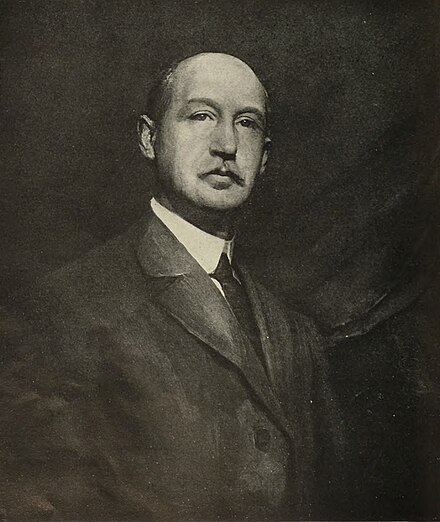
Portrait by George M. Reevs, 1909 • Public Domain
The Visionary
Walter Camp arrived at Yale in 1876 as a student and never really left. As a player, coach, and rules committee member, he would spend the next four decades transforming a chaotic rugby variant into a uniquely American game.
1880: The Line of Scrimmage
Camp's first revolutionary rule: instead of a rugby scrum, the team with the ball would have undisputed possession. The center would snap the ball to the quarterback. The line of scrimmage was born.
1882: The Downs System
To prevent teams from simply holding the ball indefinitely, Camp created the downs system: a team must advance 5 yards in 3 attempts or surrender possession. The strategic chess match of football began.
1882: Scoring Standardized
Camp established point values: 5 points for a touchdown (later 6), 1 point for the conversion kick, 2 points for a safety, and 5 points for a field goal (later 3). The modern scoring system took shape.
1888: Tackling Below the Waist
Camp legalized tackling below the waist, making defense more effective. The physical chess match intensified—but so did the injuries.
"Brutality and foul play should receive the same summary punishment given to a man who cheats at cards."
— President Theodore Roosevelt, 1905
Football had become a killing field. Mass formations like the "flying wedge" turned players into human battering rams. In 1905 alone, 19 players died and over 100 were seriously injured.
President Roosevelt, whose own son played at Harvard, summoned coaches from Yale, Harvard, and Princeton to the White House. His ultimatum was clear: reform the game or he would abolish it by executive order.
1906: The Rule That Saved Football
Before 1906
- ✕ Mass formations
- ✕ Running only
- ✕ High casualties
- ✕ Brutal collisions
After 1906
- ✓ Spread formations
- ✓ Aerial attack
- ✓ Reduced injuries
- ✓ Strategic depth
The forward pass opened the field, spread players apart, and reduced the deadly mass collisions. Football survived—and became infinitely more strategic and entertaining.
America's Game
From leather helmets to billion-dollar stadiums, football grew alongside American media and became inseparable from national identity.
Super Bowl Viewership Growth
The Modern Gridiron
Football's dominance comes with a price. The same collisions that thrill fans have sparked a crisis of conscience.
In 2002, Dr. Bennet Omalu discovered CTE (Chronic Traumatic Encephalopathy) in the brain of former Steelers center Mike Webster. The NFL initially denied the connection between football and brain damage.
Today, the league has implemented concussion protocols, banned certain hits, and paid over $1 billion in settlements to former players. Youth football participation has declined 27% since 2008.
The evolution of protective equipment mirrors football's ongoing struggle with player safety.
Legacy on the Line
From muddy college fields to gleaming billion-dollar stadiums, American football's 150-year journey is a story of reinvention.
So how did a chaotic rugby variant become America's obsession?
Through the vision of Walter Camp. Through the crisis of 1905 and Theodore Roosevelt's ultimatum. Through the forward pass that saved the game. Through television's embrace of its drama. Through the Super Bowl's transformation into a national holiday.
Football succeeded because it evolved—repeatedly, dramatically, sometimes desperately. It nearly died before it lived. And that capacity for reinvention may be what defines it most.
Sources & Further Reading
- Pro Football Hall of Fame: Birth of Professional Football
- NCAA: History of College Football
- Encyclopedia Britannica: Walter Camp
- Smithsonian Magazine: The Origins of Football
- NFL: 100 Years Timeline
- History.com: History of Football
- Statista: Super Bowl Statistics and Facts
Image Credits
- Walter Camp Portrait by George M. Reevs (1909) — Wikimedia Commons, Public DomainOriginally published in The Century Illustrated Monthly Magazine, Volume 79
This narrative was fact-checked against authoritative historical records, sports archives, and peer-reviewed research on American football history.