Science / Paleoanthropology
Turkana Boy and the first body built for range
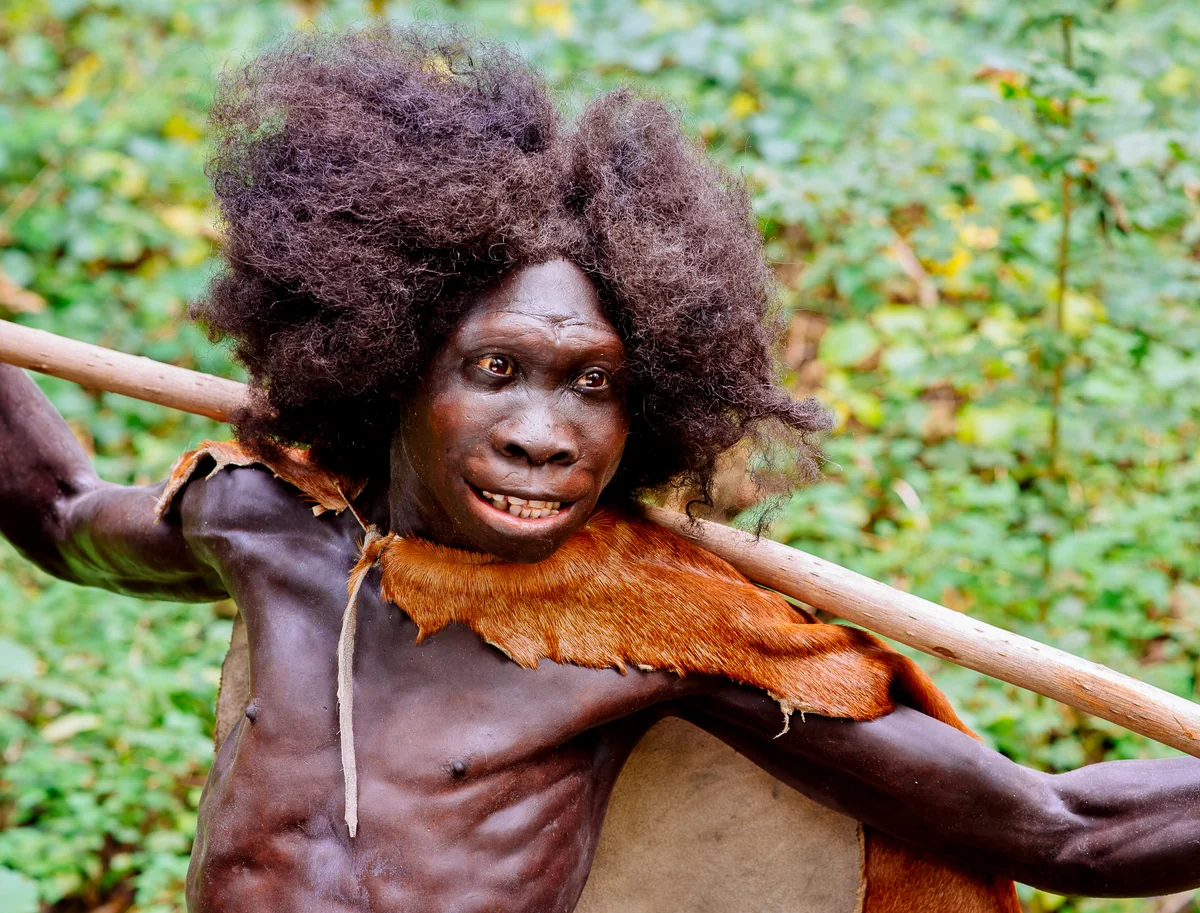
The case begins with a wound in the jaw. From that lesion, the essay widens into a larger claim: by 1.53 million years ago, our lineage had produced a body that no longer looked like a compromise between climbing and walking. It looked engineered for heat, distance, and open ground.
01
The abscess is the right beginning
The fossil does not open with triumph. It opens with pathology. A lesion below the first molar gives the essay its tone: clinical, exact, and restrained. We can describe the damage confidently. We can only cautiously infer how much pain it caused or whether it contributed directly to death. That asymmetry is the whole discipline in miniature.
Turkana Boy matters because he compresses multiple questions into one specimen. Age, growth, heat adaptation, stride length, migration, and even the limits of speech all become visible through a skeleton that is both unusually complete and still unfinished by development. He died before adulthood. The fossil is therefore a body and an interrupted future at the same time.
That is why this essay keeps returning to confidence boundaries. The jaw lesion is strong evidence. A single exact cause of death is not. The lower limbs strongly support modern-style range walking. A fully modern life history does not. Good paleoanthropology keeps the claims narrow where the evidence is narrow.
Visualization 2
Teeth say younger. Bones say older.
The disagreement matters because height and adult projection depend on it.
Tooth eruption suggests a child closer to eight or nine.
Postcranial maturation pushes some reconstructions toward eleven.
Visualization 3
An interrupted growth curve
Turkana Boy died before adulthood, so every projection is a model, not an observation.
02
The age dispute changes every later sentence
Public summaries often flatten the age question into a single number. The fossil does not cooperate. Teeth and bones are not measuring the same process, and they do not reach the same conclusion. If the dental estimate is closer to the truth, then Turkana Boy was younger and even more developmentally precocious in body form. If the skeletal estimate is stronger, then some later reconstructions become less surprising. Either way, the disagreement forces humility.
Visualization 1
Recovered body, missing body
108 bones turned a fragmentary fossil into an anatomical argument.
This is the engine room: long femora, long lower limbs, and the anatomical argument for sustained terrestrial range.
Visualization 4
The body turns into a range machine
Longer lower limbs and a narrower trunk make heat and distance part of the same story.
03
The body is the breakthrough
Lucy made upright walking undeniable. Turkana Boy makes another transition legible: the emergence of a tall, narrow, long-limbed body that treats open equatorial terrain as home rather than hazard. Long legs lengthen stride. A narrower trunk reduces heat burden. The same anatomy that helps with thermoregulation also makes distance cheaper.
This is why the essay keeps insisting on the phrase "modern body" while still resisting easy equivalence. Turkana Boy is not simply a recent human in old sediment. But he is the first fossil in the cluster that lets the ecological logic of our own build come into focus. The body is no longer merely bipedal. It is organized for range.
That claim depends less on a single glamorous metric than on a package of relations: limb proportions, trunk form, stature, and the way those features change the cost of moving through heat. The fossil matters because the package appears together.
Visualization 5
880 cc: important, but not the whole story
The skull matters, but this fossil's deeper claim is postcranial.
Visualization 6
What the vertebrae refuse to settle
Older argument
Narrowed thoracic canal could imply weaker breathing control.
- Some vertebral measurements looked too small for modern-style respiratory control.
- That opened a cautious argument against fully modern speech capacity.
04
Not a brain story alone
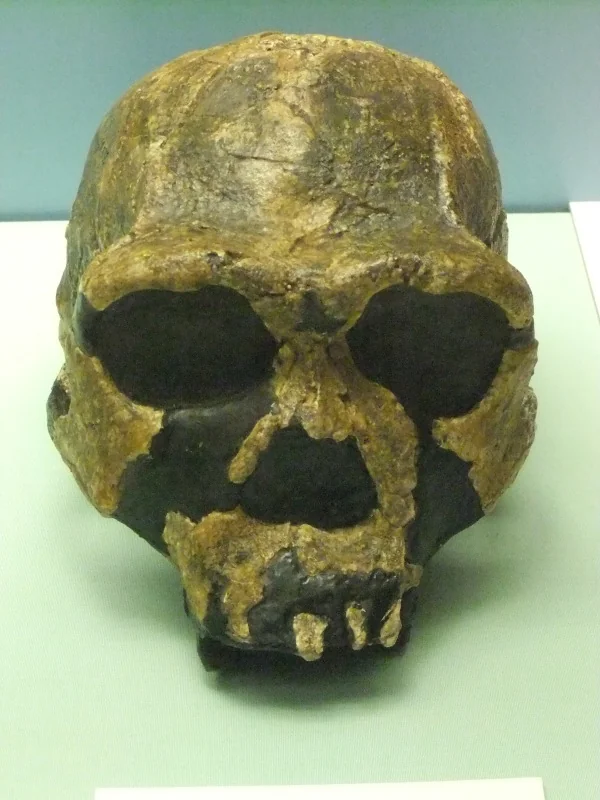
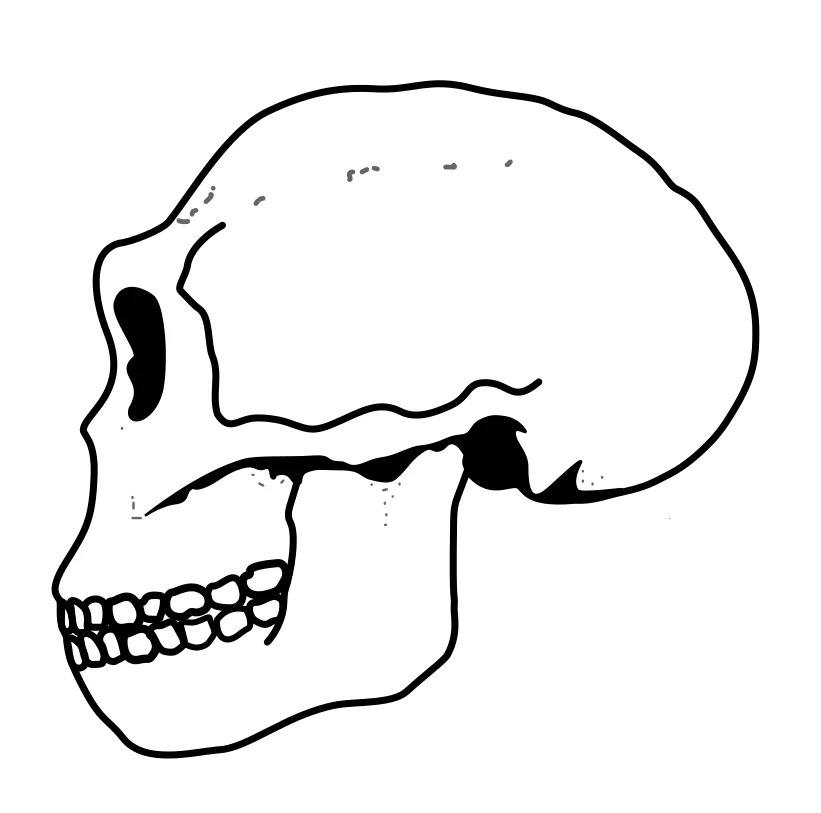
An endocranial volume near 880 cc is significant, but the temptation is to let that number dominate the narrative. It should not. Turkana Boy matters because the head and the body no longer tell separate stories. The skull is intermediate. The postcranial skeleton is already deeply consequential. This is a fossil where anatomy below the neck does most of the historical work.
The same caution applies to speech. Older arguments about the thoracic canal asked whether the skeleton lacked the breathing control needed for modern speech. Later reassessments argued that the inference was too strong. The proper lesson is not that the debate is solved; it is that fossil evidence has scale, and claims should not outrun it.
In other words: this skeleton tells us a great deal about movement and body form. It tells us much less securely about language. The essay should let those different levels of certainty remain visible.
05
Technology and terrain frame the child
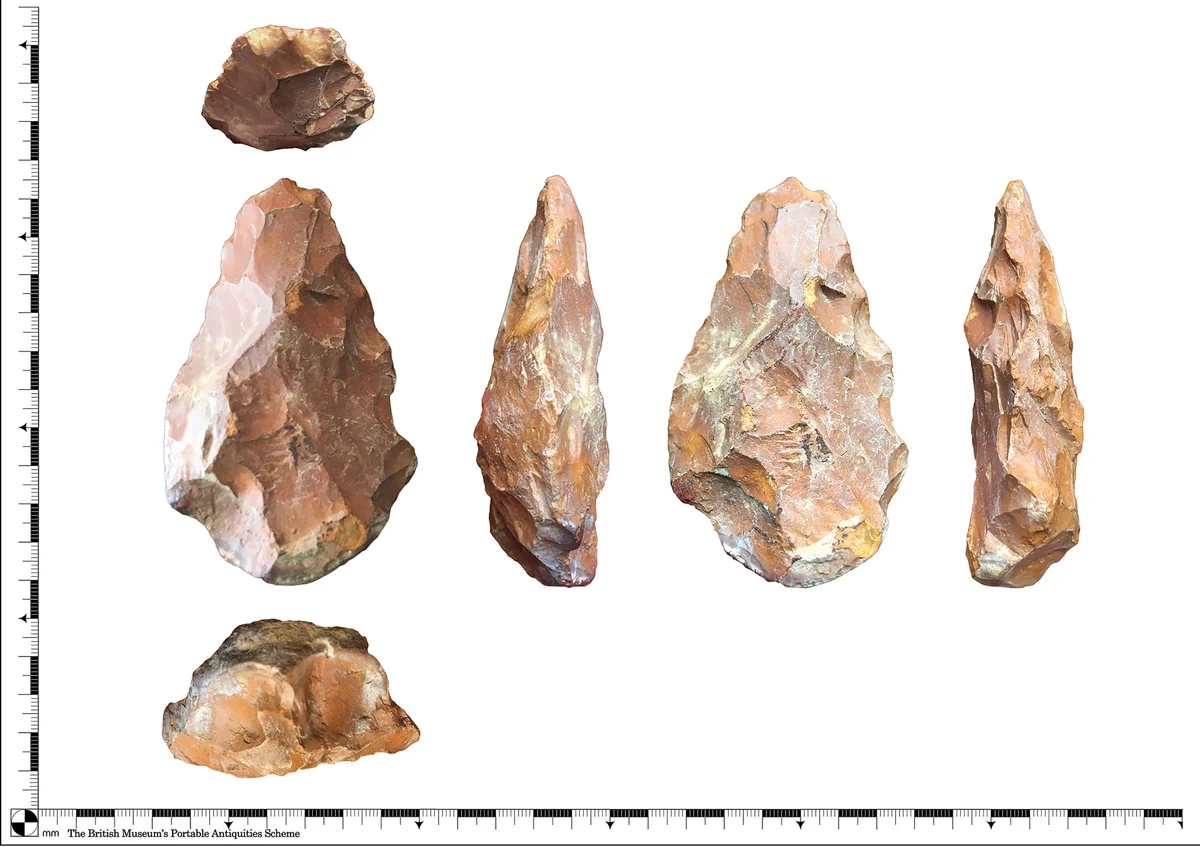
Acheulean tools appear in this essay not as props but as ecological context. Large cutting tools imply planning, repetition, and a species operating confidently in open landscapes. We cannot say that KNM-WT 15000 held one particular handaxe. We can say that his body belongs to the same expanding world in which such tools matter.
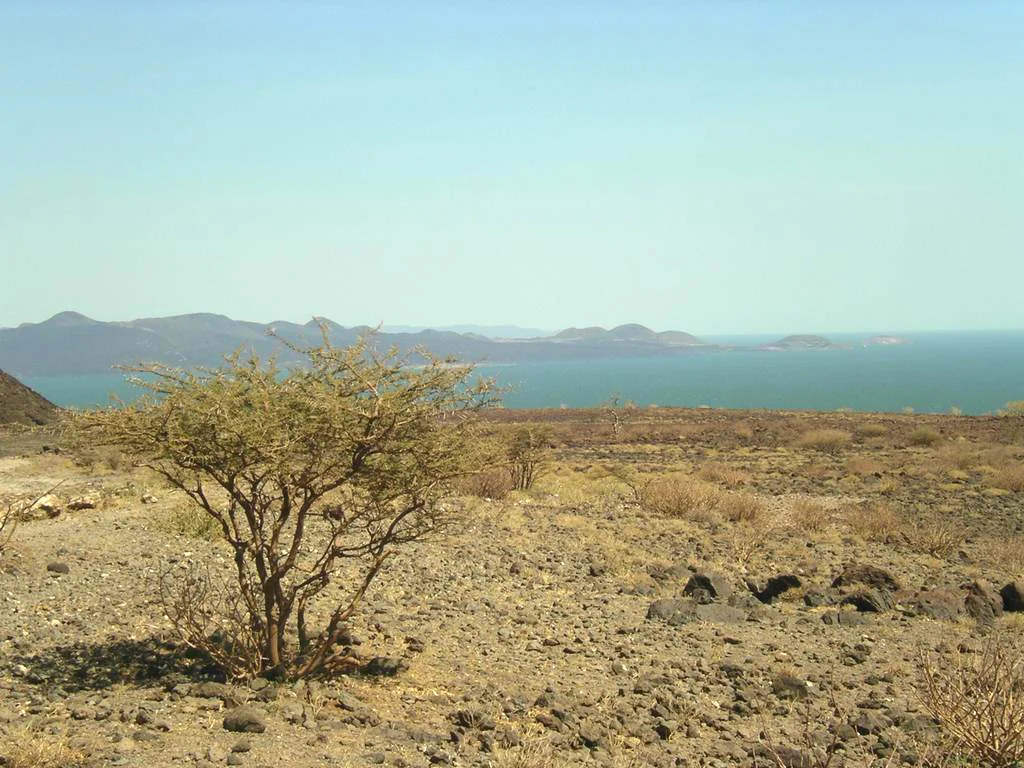
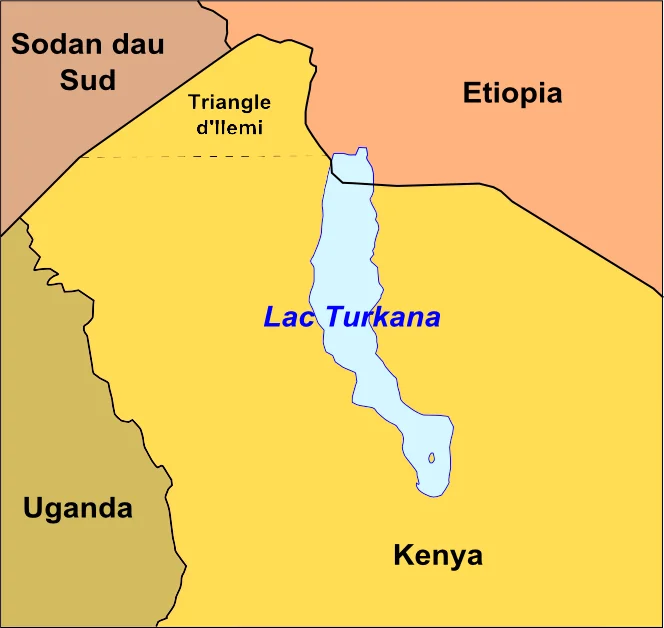
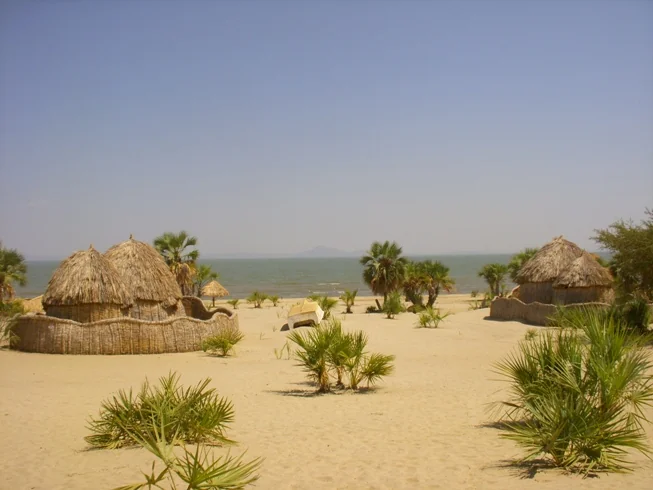
Lake Turkana is not backdrop. It is one of the essay's key explanatory surfaces: exposed sediment, open horizons, strong light, dry air, and the environmental demand for efficient cooling. The design research for this project correctly kept returning to brightness and basin scale because the argument lives there.
The lesson is that body plan, climate, and technology are braided. A taller, more heat-adapted body is not an isolated novelty. It is part of a lineage becoming more capable in exposed terrain over large distances.
Visualization 7
The body opens the map
Turkana Boy does not prove the migration by himself. He explains how it became plausible.
06
The map opens because the anatomy changes
Turkana Boy does not personally walk to Dmanisi or Java. But the skeleton helps explain why members of early Homo could leave Africa at all. The lower limbs, trunk shape, stature, and overall body economy turn dispersal into a biomechanical possibility rather than a narrative abstraction.
07
Discovery returns the story to people
Kamoya Kimeu's discovery in 1984 reminds us that scientific revolutions often begin with field attention, not abstract theory. The skeleton became famous later. First it had to be noticed, excavated patiently, and reconstructed across seasons. Five field seasons and 108 bones turned a locality into a benchmark.
This matters for tone as much as for history. The essay starts with a jaw lesion and ends with inheritance, but discovery sits in the middle as a human hinge. Evidence is never just sitting there. Someone had to see it, pick it out from the slope, and recognize what it might become.
That is the emotional arc hidden inside the forensic one. A child's remains, preserved incompletely, become one of the clearest windows onto our own body plan. Precision and pathos are not enemies here. They are the same story told at different scales.
08
The first draft still walking
What makes Turkana Boy moving is not simply the tragedy of a child who died young. It is the compression of familiarity into deep time. His body is still different from ours in meaningful ways. But the overall design no longer feels alien. When the essay lands, it should make the reader notice their own stride.
Lucy shows that walking upright begins before large brains. Homo naledi shows that small brains do not prevent surprising behavior. Turkana Boy marks a different threshold: the moment the body itself begins to look unmistakably pointed toward ours. Not complete. Not final. But already organized for the open world we still inhabit.
09
Sources
The essay is built from primary fossil description, growth-model debates, locomotor analysis, and museum or archive image records consolidated in `SOURCES` and `IMAGE_CREDITS`.
- [1]Brown, F., Harris, J., Leakey, R. & Walker, A. (1985). Early Homo erectus skeleton from west Lake Turkana, Kenya. Nature, 316, 788-792.
- [2]Walker, A. & Leakey, R. (eds.) (1993). The Nariokotome Homo erectus Skeleton. Springer-Verlag.
- [3]Smithsonian Human Origins Program. KNM-WT 15000 fossil profile.
- [4]African Fossils / National Museums of Kenya. KNM-WT 15000 mandible specimen page.
- [5]Lepre, C.J. et al. (2011). An earlier origin for the Acheulian. Nature, 477, 82-85.
- Turkana Boy reconstruction at the Neanderthal MuseumNeanderthal Museum / Wikimedia Commons, CC BY-SAArchive record
- Lake Turkana landscape photographAdamPG / Wikimedia Commons, CC BY-SA 3.0Archive record
- Lake Turkana mapNicolas Eynaud / Wikimedia Commons, CC BY-SA 3.0Archive record
- View of Lake Turkana from Eliye SpringsWikimedia Commons, CC BY-SAArchive record
- Acheulean bifaced ovate hand axePortable Antiquities Scheme / Wikimedia Commons, CC BY-SA 4.0Archive record
- Homo ergaster skull illustrationJose-Manuel Benito / Wikimedia Commons, CC BY-SA 2.5Archive record
- Homo ergaster skull replica at World Museum LiverpoolJohnbod / Wikimedia Commons, CC BY 3.0Archive record