How did he know?

The Architecture of Unfreedom
How George Orwell Built 1984 from the Horrors He Witnessed
The Face Behind the Warning
This face — gaunt, serious, prematurely aged by disease and war — belonged to a writer who had less than five years to live. He was spending those years in physical agony, racing to finish a warning.
Nineteen Eighty-Four is often taught as speculative fiction, a “what if” about a future that never arrived. This essay will demonstrate that it is closer to historical testimony. Every mechanism of control in Oceania traces to something Eric Arthur Blair — the man behind the pen name — witnessed firsthand.
To understand 1984, we must understand the man who wrote it.
The Colonial Policeman
Burma, 1922–1927At nineteen, Eric Blair joined the Indian Imperial Police and shipped to Burma. He would serve five years as an enforcer of British colonial rule — supervising prisons, witnessing executions, carrying the authority of empire.
He hated it. Not immediately — he was a product of his class and education — but increasingly, viscerally. He saw how power works on the ground: the casual racism, the systemic violence, the way the colonized are rendered less than human to justify their subjugation.
I perceived in this moment that when the white man turns tyrant it is his own freedom that he destroys.
Burma gave Orwell something no book could: intimate knowledge of what it feels like to be an instrument of oppression. He knew the Thought Police because he had been the police.
Connection to 1984: Understanding how power operates at ground level; the psychology of the enforcer; the Party's inner mechanics.
Down and Out
Paris & London, 1928–1933In 1927, Orwell resigned from the Imperial Police. The decision was deliberate — and devastating. He was rejecting his class, his income, his future. He wanted, he later wrote, to escape from “every form of man's dominion over man.”
But that wasn't enough. He needed to understand what it felt like to be at the absolute bottom of society. So he went there.
I wanted to submerge myself, to get right down among the oppressed, to be one of them and on their side against their tyrants.
For months, he lived as a tramp in London and a plongeur (dishwasher) in Paris. He slept in doss-houses, wore rags, went hungry. He was arrested for drunkenness. He scrubbed dishes in basement kitchens for eighteen hours a day.
This wasn't poverty tourism. It was methodical immersion. Orwell was gathering material — not just for a book, but for a worldview. He was learning how degradation works, how hopelessness is manufactured, how the system keeps the poor too exhausted to resist.
The Proles of 1984
In Nineteen Eighty-Four, 85% of Oceania's population are proles — kept in poverty, fed cheap entertainment, ignored by the Party because they are deemed incapable of political thought.
Winston hopes the proles might one day rise up. But they never do. They are too busy surviving.
If there is hope, it lies in the proles... But until they become conscious they will never rebel, and until after they have rebelled they cannot become conscious.
Connection to 1984: The proles — kept in poverty, distracted by the lottery, fed pornography and cheap beer, dismissed as subhuman by Party members. Orwell knew them because he had lived among their real-world equivalents.
The Soldier
Spanish Civil War, 1936–1937
George Orwell
The Wounded Soldier
- Joined POUM militia to fight Franco's fascists
- Shot through throat by sniper, May 20, 1937
- Witnessed Stalinist suppression of fellow leftists
- Barely escaped NKVD-influenced police in Barcelona
“Every line of serious work that I have written since 1936 has been written, directly or indirectly, against totalitarianism.”
— Why I Write, 1946
This is the crucible. Everything Orwell became, everything he wrote from 1937 onward, traces to Spain.
On May 20, 1937, a fascist sniper shot him through the throat. The bullet passed through his neck, missing his carotid artery by millimeters. He survived, but his voice was permanently damaged.
Yet the bullet was not the worst wound Spain inflicted.
In May 1937, the Soviet-backed Communists turned on their own allies. The NKVD, Stalin's secret police operating in Spain, suppressed POUM as “Trotskyist-fascist.” Orwell's comrades were arrested, some disappeared forever. He and his wife barely escaped Barcelona.
I saw newspaper reports which did not bear any relation to the facts, not even the relationship which is implied in an ordinary lie... I saw, in fact, history being written not in terms of what happened but of what ought to have happened according to various 'party lines.'
Connection to 1984: Spain gave Orwell the Ministry of Truth. It gave him the Party's ability to change the past. It gave him the purges. And it nearly killed him twice — once by fascist bullet, once by Stalinist betrayal.
The Propagandist
BBC Eastern Service, 1941–1943
Senate House, London — Orwell's BBC office. The building that became the Ministry of Truth.
In August 1941, Orwell joined the BBC's Eastern Service as a Talks Producer, creating propaganda broadcasts aimed at India. His office was in Senate House, a massive brutalist tower near the British Museum.
He produced over 200 radio programs, working with distinguished writers like T.S. Eliot. But he came to despise the work.
I have wasted two years of my life doing hack work that was mostly either useless or harmful.
The BBC taught Orwell how truth is manufactured at scale. Winston Smith's job rewriting old newspaper articles at the Ministry of Truth is drawn directly from Orwell's understanding of how official reality is produced.
The Model
Stalin's Soviet Union, 1930s–1940s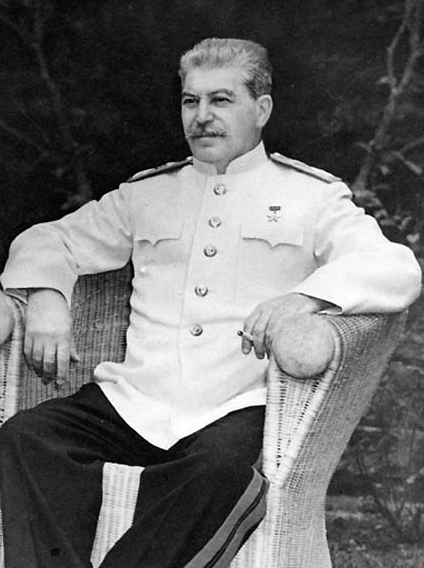
Joseph Stalin
The Real Big Brother
- Personality cult: giant portraits, infallibility doctrine
- Moscow Show Trials: forced impossible confessions
- Great Terror: 750,000+ executed, millions to gulags
- Systematic rewriting of history, erasure of enemies
Oceania is not a fantasy. Its primary model was the USSR under Joseph Stalin.
Big Brother's omnipresent face mirrors Stalin's personality cult. The Two Minutes Hate echoes Soviet denunciation sessions. The purges that “vaporize” Party members mirror the Great Terror.
But the most precise parallel is historical revision.
The Yezhov Demonstration
Nikolai Yezhov ran the NKVD at the height of the Great Terror. He personally signed execution lists, earning the nickname “The Bloody Dwarf.” In 1938, he fell from favor. In 1940, he was executed.
Then he was erased from history.


1940. Yezhov is executed.
“He had been vaporized, as the phrase was.”
This is EXACTLY what Winston Smith does at the Ministry of Truth. This is what memory holes are for. This is why “who controls the past controls the future.”
The Spectacle
Nazi Germany, 1933–1945Stalin's USSR provided one template for Oceania. But Orwell was equally horrified by Hitler's Germany — a different flavor of totalitarianism, focused less on ideological purity and more on spectacle, emotion, and mass psychology.

Nuremberg Rally, 1936 — The orchestrated fusion of terror and ecstasy.
The Nuremberg rallies were designed by Albert Speer to overwhelm the senses — towering columns of light, thousands of synchronized marchers, Hitler's voice rising to screaming crescendo. The goal was not rational persuasion but emotional subjugation.
The horrible thing about the Two Minutes Hate was not that one was obliged to act a part, but, on the contrary, that it was impossible to avoid joining in.
Winston describes feeling genuine hatred during the Two Minutes Hate — not because he believes in it, but because mass emotion is contagious. You cannot stand in a crowd of screaming people and remain unmoved. The body betrays the mind.
Nazi Germany
- Joseph Goebbels: Ministry of Propaganda
- Book burnings, controlled press
- Nuremberg rallies: mass emotional manipulation
- Enemies: Jews, Bolsheviks, degenerates
Oceania
- Ministry of Truth: news and entertainment
- Memory holes, rewritten newspapers
- Two Minutes Hate: directed rage sessions
- Enemies: Goldstein, Eurasia/Eastasia
Goebbels understood that propaganda works best when people don't recognize it as propaganda — when hatred feels like natural righteous anger, when loyalty feels like love. The Two Minutes Hate is not just about directing anger at Goldstein. It's about making that anger feel authentic.
The essence of propaganda consists in winning people over to an idea so sincerely, so vitally, that in the end they succumb to it utterly and can never escape from it.
Connection to 1984: The mass rallies, the orchestrated emotion, the transformation of hatred into ecstasy. Oceania fuses Soviet ideological control with Nazi psychological manipulation.
The Dying Prophet
Jura, 1946–1950After the war, Orwell was a successful writer — Animal Farm had made him famous. But he was also dying.
He chose to spend his remaining years on Jura, a remote Scottish island accessible only by boat and rough track. The farmhouse at Barnhill had no electricity. It was the end of the world.
Here, coughing blood, often bedridden, Orwell wrote Nineteen Eighty-Four.
The urgency of 1984, its relentless bleakness, its refusal of hope — these come from a dying man who knew he was running out of time.
The Novel
Oceania, 1984
Now we understand what Orwell poured into the novel. Every mechanism of Oceania traces to something he witnessed.
But 1984 is not merely a political allegory. At its heart is a love story — and its destruction.
Winston and Julia find each other. Their affair is rebellion — claiming something human, something private, something the Party cannot control. For a few brief weeks, they are alive.
And then Room 101.
Do it to Julia! Do it to Julia! Not me! Julia! I don't care what you do to her. Tear her face off, strip her to the bones. Not me! Julia! Not me!
The Party doesn't kill Winston and Julia. It makes them betray each other. “Do it to Julia!” Winston screams, offering the woman he loves to the rats.
This is the Party's true victory. Not death — destruction of the capacity for love.
Winston's humanity — his ability to love, to resist, to remain himself — has been annihilated. The Party wins not by killing the body but by destroying the soul.
The Warning That Endures
George Orwell died on January 21, 1950. His tombstone, as he requested, bears his real name: Eric Arthur Blair.
1984 has never gone out of print. It has been translated into over 65 languages. Its vocabulary — Big Brother, thoughtcrime, doublethink, Newspeak, Room 101 — has entered common speech.
Orwell feared he was writing about what might happen. We can assess how muchdid happen — surveillance states, contested reality, permanent war, the manipulation of language. But that assessment is for readers to make.
What Orwell offered was not prophecy but a diagnostic kit. He showed us the mechanisms — the boot, the telescreen, the memory hole, the Two Minutes Hate, the destruction of love through betrayal — so we might recognize them if we saw them.
If you want a picture of the future, imagine a boot stamping on a human face — forever.
Orwell had seen that boot. He had worn it, faced it, fled from it. He knew what he was warning against because he had lived it.
His warning endures because the mechanisms endure. The question is whether we are listening.
Sources & Further Reading
- Orwell, George. Nineteen Eighty-Four. Secker & Warburg, 1949.
- Orwell, George. "Why I Write." Gangrel, 1946.
- Orwell, George. Homage to Catalonia. Secker & Warburg, 1938.
- Orwell, George. Down and Out in Paris and London. Victor Gollancz, 1933.
- Orwell, George. The Road to Wigan Pier. Victor Gollancz, 1937.
- Crick, Bernard. George Orwell: A Life. Secker & Warburg, 1980.
- Lynskey, Dorian. The Ministry of Truth: The Biography of 1984. Doubleday, 2019.
- Arendt, Hannah. The Origins of Totalitarianism. Schocken, 1951.
- The Guardian: Original 1949 Review of Nineteen Eighty-Four.
- Encyclopaedia Britannica: George Orwell.
This narrative was fact-checked against peer-reviewed sources, authorized biographies, and Orwell's own essays and correspondence.